Eyesight numbers · −1.75 explained
Is −1.75 Eyesight Bad?
−1.75 is still in the mild band, but it is the firmer end of it — enough that most people wear glasses for distance through the day rather than just for driving. Your sharp world reaches about 57 cm, a little past arm's length, before things soften. Close work stays clear; it is the room and beyond that calls for lenses.
Your glasses number
−1.75diopters
−1.75 is in the upper part of the mild band (−0.25 to −3.00) — stronger than −0.50 or −1.25, but still short of the −3.25 moderate threshold. It is the level where mild nearsightedness stops being a part-time, for-driving thing and becomes a wear-them-most-days number.
What −1.75 actually means
One meter divided by 1.75 is about 57 cm — roughly the distance from your eyes to a laptop screen. Inside that the world is sharp; past it, edges start to go. So a monitor at a normal sitting distance is right at the edge, a person across a table is softening, and anything across a room — a wall clock, a TV, a face two tables over — is noticeably fuzzy without lenses. It is the level where many people stop taking the glasses off during the day, because the blur reaches in far enough to be a nuisance.
−1.75 is a step up from −1.25 in a way you can feel. At −1.25 the clear zone reaches 80 cm and you mostly lose the far wall; at −1.75 it pulls in to under 60 cm, so mid-room distances go too. That half-diopter is the difference between “glasses for the car” and “glasses most of the time.” It is still mild and still corrects fully, but it is the part of mild where lenses become a daily habit.
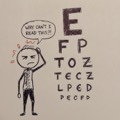
On a wall chart, bare-eyed −1.75 lands somewhere around 20/70 — the top rows only. With glasses on it is a clean 20/20. And it is nowhere near anything serious: legal blindness is judged with the best lenses on, and −1.75 corrects to sharp many times over.
See where any number lands
−1.75is one point on the scale. The free interactive explainer takes any 20/xx chart result or glasses number and shows the clear distance, the mild-to-high band, and what “legally blind” does and doesn't mean — with the diagrams above and a side-by-side chart-to-glasses table.
Open the eyesight-numbers explainer →
Not sure which line is yours? The free online eye test draws a real letter chart sized for your screen and your distance and reads a 20/xx line per eye. Test your own line →
Have the paper from the optician? The free eye prescription calculator explains every number on it.
Common questions
Is −1.75 eyesight bad?
It is still mild, but the firmer end of mild. Your sharp world ends around 57 cm, so distance across a room is fuzzy without glasses and most people wear them through the day rather than just for driving. Close work is unaffected and it corrects to a full 20/20 — common and easily handled, just enough to make glasses a daily habit.
What is the difference between −1.25 and −1.75?
Half a diopter, and you can feel it. At −1.25 your clear zone reaches about 80 cm, so you mostly lose only the far wall; at −1.75 it pulls in to under 60 cm, so mid-room distances soften too. That gap is roughly the difference between glasses just for the car and glasses for most of the day.
Do I need to wear glasses all the time at −1.75?
Many people do, because the blur reaches in far enough — to within about 57 cm — to be a nuisance for anything across a room. Close-up work doesn't need them. Whether you wear them full-time comes down to how much of your day involves looking at distance.
What is 20/xx for −1.75 vision?
Bare-eyed, −1.75 lands around 20/70 on a wall chart — the top rows only. That is a ballpark, since the chart and the glasses number measure different things. With glasses on, −1.75 reads the full 20/20 line.
What to do with your number
The full method is a structured 90-day program — proper lenses, measured progress, the things only experience can tune.
EndMyopia members work on lowering their glasses numbers step by step. The whole thing — your numbers explained, lens recommendations, daily habits, weekly check-ins — lives inside BackTo20/20. Full Program $997 $997 once · or $99/mo × 12 · lifetime access · money-back guarantee.
Full program USD 997 · money-back guarantee
Or keep exploring with the free Eyeball Analyzer (20 minutes, your numbers, what they mean).
Limitations & disclaimer
EndMyopia treats myopia as a refractive state, not a medical condition. This is a free educational tool — not medical advice, diagnosis, or a substitute for a licensed optometrist. Measurements depend on camera quality and how carefully you mark the card edges; expect ±5–10 % on laptops, ±10–15 % on phones. For lens orders, eye health concerns, or any task requiring full 20/20 vision, see a licensed professional.
Your glasses are a subscription
Designed to keep your eyes blurry.

Simple therapy can get your real eyes back. — Jake Steiner, vision biologist turned eye guru
Get your real eyes back →