APP-008 · Self-refraction · Camera + card
Measure your diopter.
No optometrist required.
Calibrate with any wallet-size card held to your forehead, then find the distance at which on-screen text first blurs — per eye. That distance, converted, is your myopia diopter. 90 seconds, in-browser, nothing uploaded.
Camera + a credit card · 90 seconds
Analyze my eyeballs
No lens paperwork? We can find your numbers right now using your phone's camera and any wallet-size card. Card sets the scale, your face sets the distance, the distance gives us your diopter. Runs in your browser.
Nothing is uploaded. Calibration stays on this device.
How this measures it
Step 1 calibrates: an ISO/IEC 7810 ID-1 card (credit card, driver's licence, most national IDs) is exactly 85.6 mm wide. Held flat against your forehead, the card sits in the same depth plane as your eyes, so its pixel width sets the scale. From that we derive your personal interpupillary distance in millimeters.
Step 2 measures per eye: with one eye covered, you slowly move the phone away from your face. Iris detection (Google's MediaPipe Face Landmarker, running locally) tracks your iris pixel width frame by frame; with the calibration, that pixel width converts to a real-world distance in centimeters. Tap Capture the moment text first blurs.
Step 3 converts cm to diopters via the standard relationship D = 100 / cm, rounded to the nearest 0.25 D step (orderable lens precision). Approximate, not optometrist-grade — but the same math the centimeter method uses, just measured by the camera instead of a ruler.
All of this runs in your browser. No frames are uploaded. Calibration is shared with the other camera tools — calibrate once, all of them work.
Knowing your number is step one.
Reducing it is the whole point.
BackTo20/20 — the structured 90-day program. Proper lenses, measured progress, the things only experience can tune. Full Program $997 one payment · or $99/mo × 12 · lifetime access · money-back guarantee.
Limitations & disclaimer
EndMyopia treats myopia as a refractive state, not a medical condition. This is a free educational tool — not medical advice, diagnosis, or a substitute for a licensed optometrist. Measurements depend on camera quality and how carefully you mark the card edges; expect ±5–10 % on laptops, ±10–15 % on phones. For lens orders, eye health concerns, or any task requiring full 20/20 vision, see a licensed professional.
Your glasses are a subscription
Designed to keep your eyes blurry.
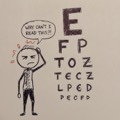

Simple therapy can get your real eyes back. — Jake Steiner, vision biologist turned eye guru
Get your real eyes back →