Small print, sharp again. Your exact reading glasses strength, measured.
The weakest pair that works, for your phone, a book, a laptop and a monitor. Two minutes, nothing uploaded.

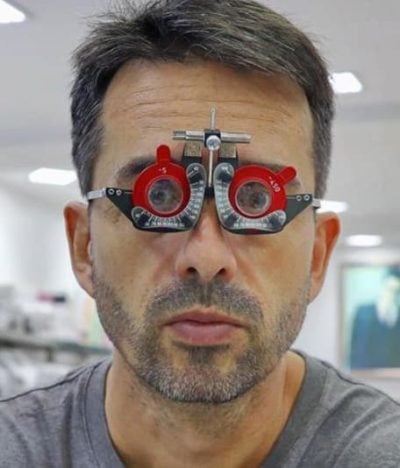
Built by Jake Steiner
Founder and Research Director, endmyopia
Step 1 · What you read
What do you need them for?
The strength depends on how far away you hold it. Pick the one that matters most; the result covers all four.
Who made this
Jake Steiner. Founder and Research Director, endmyopia. Twenty years of reduced-lens myopia work, 470 videos, 70,000 subscribers, and the person who named most of the vocabulary this corner of the internet uses.
Reading glasses strength by age
The chart printed on most reader displays. It is an average, and people the same age can sit a full step apart, which is why a measured near point beats it.
| Age | Typical strength |
|---|---|
| 40 to 44 | +0.75 to +1.00 |
| 45 to 49 | +1.00 to +1.50 |
| 50 to 54 | +1.50 to +2.00 |
| 55 to 59 | +2.00 to +2.25 |
| 60 and up | +2.50 to +3.00 |
How the test works
Focusing up close is work for the eye, measured in diopters: print at 40 cm costs 100 ÷ 40 = 2.5 diopters, print at 25 cm costs 4. The closest distance at which small print stays sharp marks where the eye runs out, so 100 divided by that distance is the range it has. Through the forties that range shrinks, the closest sharp point moves outward, and at some point it passes the length of your arms.
Using the whole range is tiring after a few minutes; using half of it is comfortable for an hour. Readers add the rest. The strength the test gives is the reading distance in diopters minus half the measured range, rounded up to the next 0.25 step, which is the weakest pair that keeps that margin.
The print is set at 5 points, the standard size for this measurement, after the screen is scaled against a bank card. The distance comes from the camera, which learns the millimetres between your pupils from the same card, the calibration the reading-distance tool runs, or from a ruler you hold yourself.
Where a measurement like this runs out
A near point read by eye is worth about a quarter step either way: light, tiredness and how slowly you move all shift it a few centimetres. Take the test twice and use the nearer reading. It also measures both eyes together, which is how ready-made readers are made; if your two eyes differ, a pair made to measured numbers for each eye will suit you better.
Frequently asked
What strength reading glasses do I need?
Measure the closest distance at which small print stays sharp. 100 divided by that distance in centimetres is your focusing range in diopters. The weakest comfortable strength is 100 divided by your reading distance, minus half that range, rounded up to the next 0.25. The test above does the measuring and the arithmetic.
How do I know if I need +1.00 or +1.50?
Hold print where you actually read it. If +1.00 keeps it sharp without effort for several minutes, +1.00 is enough. If the letters soften after a while or you push the page away, try the next step up. When two strengths both read well, the weaker one gives a wider sharp range.
What happens if reading glasses are too strong?
The sharp range moves in close and gets shorter. Print has to be held nearer than is natural, and anything past arm's length blurs. A +2.50 pair, for example, is sharp only up to about 40 cm, so it works for a book and fails for a monitor.
Can I use the same readers for the computer?
Usually a weaker pair works better for a screen. A monitor sits at 55 to 70 cm, further than a book, so it needs less help. Many people end up with one pair for the phone and books and a lower one, often 0.75 to 1.00 weaker, for the desk.
Why does my reading distance keep getting longer?
The range of focus narrows slowly with age, so the closest sharp point drifts outward through the forties and fifties. Arms stop being long enough at some point, usually somewhere in the mid forties, and that is when people first reach for readers.
Do I need a professional to choose reading glasses?
For ready-made readers with both eyes alike, a measured near point is a sound basis. See a licensed professional if one eye differs clearly from the other, lines look doubled or tilted, or the change came on suddenly or with pain, flashes or new floaters.
This is a free educational tool, for choosing ready-made readers. It does not examine the eye or replace a licensed optometrist. Results depend on how carefully the screen is scaled and the distance is measured; expect about a quarter step of spread either way. For eye health concerns or any sudden change in vision, see a licensed professional.
Next tools
 APP-001Measure PD (pupillary distance)
 APP-002Learn Active Focus
 APP-003Measure CM Distance
 APP-005Contacts ↔ glasses converter + vertex chart
 APP-006Centimeter Ledger
 endmyopiaThe program →
Keep reading


Your glasses are a subscription
Designed to keep your eyes blurry.
Simple habits can get your real eyes back. — Jake Steiner, founder and research director of endmyopia
Get your real eyes back →